
The short version:
-
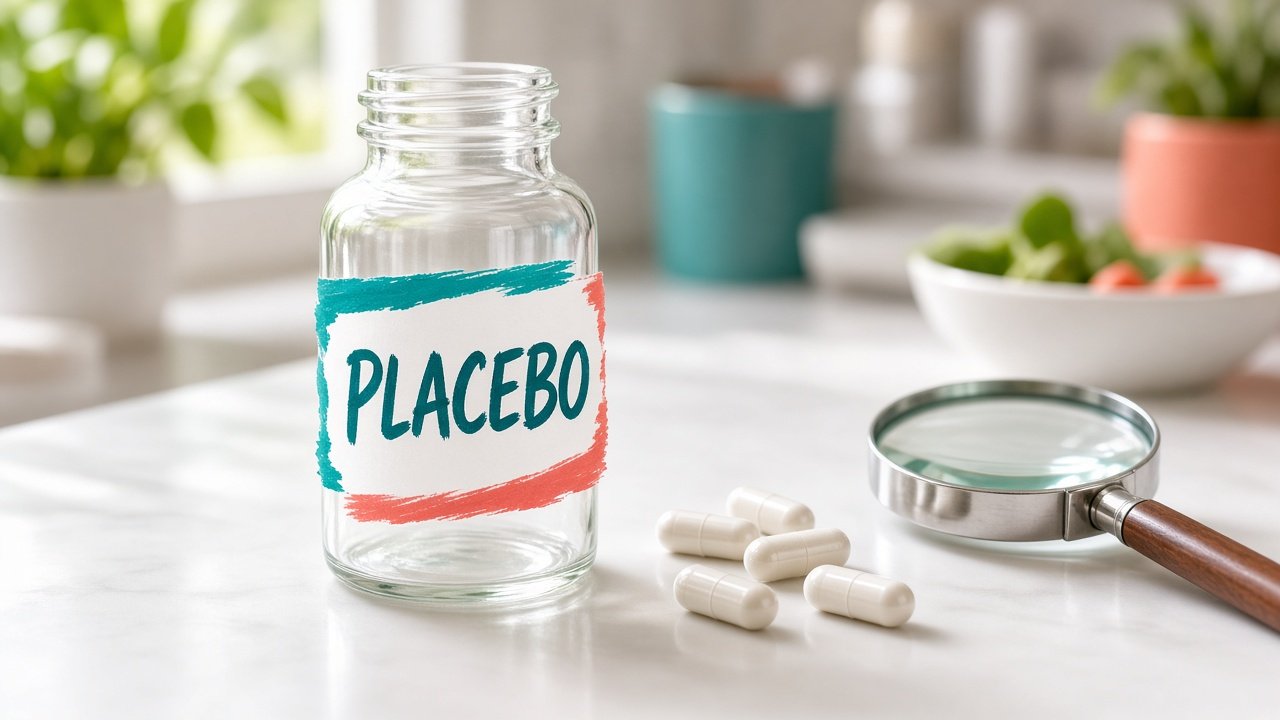
An open-label placebo is a pill with no active drug, taken by someone who knows it’s a placebo.
-
In several small randomized trials, people taking one reported feeling better than people taking nothing, with a moderate-to-large average effect.
-
The studies were short and results varied, so it might help you and it might not.
For most of medical history, a placebo only “worked” if you were fooled. Doctors handed out sugar pills and let patients believe they were real medicine. Researchers then used placebos as the yardstick that real drugs had to beat, with participants kept in the dark about which pill they got.
So here’s the strange question a group of researchers decided to test about 15 years ago: what happens if you tell people the truth? What if you hand someone a bottle that literally says “placebo” and they take it anyway?
That’s an open-label placebo, sometimes called an honest placebo or a placebo without deception. This post explains what it is, what the published studies found, how big the effects actually were, and what we still don’t know.
What “open-label” means
In drug research, “open-label” means everyone knows what’s being given. There’s no blinding and no trick. An open-label placebo is a pill with no active drug in it, given to someone who has been told plainly that it has no active drug in it.
The pill itself does nothing chemically. The idea being tested is whether the ritual around it (taking something on purpose, every day, with a positive expectation and a reason to pay attention to how you feel) can still shift how people experience symptoms like pain or fatigue, even with full honesty.
Open-label vs. regular placebo
A conventional placebo depends on uncertainty. In a blinded trial you might be getting the real drug, so your expectations rise. In everyday practice, a deceptive placebo means a doctor lying to a patient, which most ethicists reject.
An open-label placebo removes the deception completely. You know what it is. That’s why researchers find it interesting: if it helps at all, it’s something people could choose for themselves with fully informed consent.
The study that started it: Kaptchuk et al., 2010
The first well-known randomized trial came from Ted Kaptchuk’s group at Harvard and Beth Israel Deaconess. They enrolled 80 adults with irritable bowel syndrome. Half got a bottle labeled “placebo pills” and were told the pills were inert, like sugar pills, but that placebo effects can be powerful. The other half got no pills but the same amount of time and attention from the care team.
After three weeks, the placebo group reported significantly better scores on the study’s global improvement scale (an average of 5.0 vs. 3.9 on a 7-point scale) and better results on symptom severity and “adequate relief” measures. Quality of life only trended better and didn’t reach statistical significance.
Source: Kaptchuk et al., PLoS ONE, 2010
Worth knowing: it was a small, single-center, three-week trial, and the outcomes were self-reported. It showed the idea was worth testing, not that it was settled.
Chronic low back pain: Carvalho et al., 2016
A team in Portugal, working with Kaptchuk, randomized 97 adults with low back pain lasting more than three months. Everyone kept their usual care. One group also took open-label placebo pills twice a day for three weeks.
On a 0-to-10 pain scale, the placebo group’s composite pain dropped by about 1.5 points, compared with about 0.2 points for usual care alone. Disability scores improved by about 2.9 points in the placebo group and essentially zero in the usual-care group. When the usual-care group was later offered the placebo pills for three weeks, they showed a similar improvement.
Source: Carvalho et al., Pain, 2016
Limits: 83 people finished the trial, it lasted three weeks, nobody could be blinded (they knew which group they were in), and pain is self-reported. A 1.5-point drop is noticeable for many people, but it isn’t a cure, and some participants improved little or not at all.
What happens when you pool the studies?
One study can be a fluke, so a meta-analysis matters more. In 2021, von Wernsdorff and colleagues reviewed randomized trials that compared open-label placebos to no treatment. They found 13 studies and pooled 11 of them, covering conditions including back pain, cancer-related fatigue, ADHD, allergic rhinitis, depression, IBS, and menopausal hot flashes.
The overall effect was a standardized mean difference of 0.72 (95% confidence interval 0.39 to 1.05). In plain terms, that’s a moderate-to-large average effect on the symptoms people reported.
Source: von Wernsdorff et al., Scientific Reports, 2021
The authors were careful, and so should we be. The results varied a lot between studies (statistically, very high heterogeneity), the risk of bias was rated moderate, most trials were small and short, and they concluded the research “is in its infancy.” Averages also hide individuals: some people respond, some don’t, and no study can tell you in advance which group you’ll be in.
Why might an honest placebo help?
Nobody knows for sure. The leading explanations, discussed by Kaptchuk and Miller in an analysis in The BMJ (2018), include:
-
Expectation. Even when you know it’s a placebo, being told it might help can change what you notice and how you interpret it.
-
Conditioning. Your body has learned over a lifetime that taking a pill is followed by feeling better.
-
Ritual and attention. A daily routine that prompts you to check in with yourself can shift how symptoms feel.
These effects show up mostly in subjective symptoms, things you feel and report, like pain, fatigue, or how bothered you are. There’s no good evidence that a placebo of any kind shrinks tumors, lowers blood sugar, or fixes an underlying disease. An open-label placebo is not a replacement for medical care or for any medication you’ve been prescribed.
The honest bottom line
Here’s what we can say with a straight face:
-
Several randomized trials found that people who knowingly took placebo pills reported feeling better than people who took nothing.
-
The average effects were real and sometimes sizable, but the studies were small and short, and results varied.
-
Not everyone responds. It might help you, and it might not.
-
It costs little to try, involves no deception, and contains no active drug.
That’s not a miracle. It’s an interesting, honest option that a growing body of research says is worth taking seriously.
Trying it yourself
That’s why we make Magic Bullet: a plainly labeled placebo with nothing active inside, so you can try the ritual with full knowledge of what you’re taking. You can start with the Magic Bullet Placebo Pills, 120 vegan capsules, or save with the Magic Bullet 2-Pack. For kids, there’s Magic Bullet JR chewable tablets, and for bedtime worries, the No Ghost repellent cream turns lights-out into a ritual.
If you try it, keep taking any treatment your doctor recommended, and give it an honest few weeks. Then decide for yourself.
These statements have not been evaluated by the Food and Drug Administration. This product is not intended to diagnose, treat, cure, or prevent any disease.


